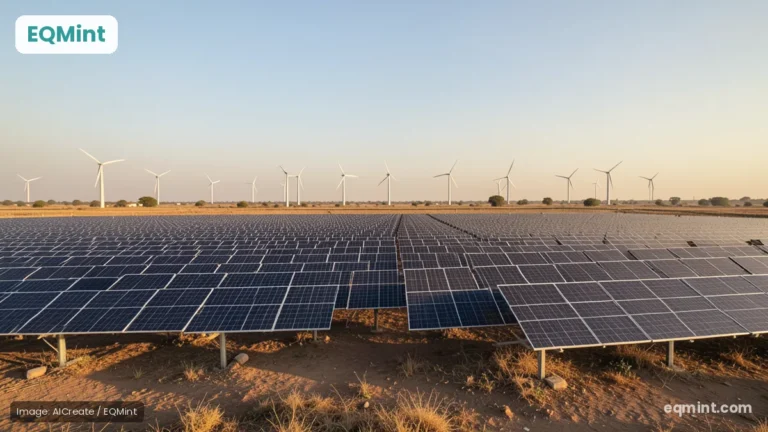
Synopsis: India added a record 8.4 GW of open-access solar in January-September 2026, up 29% year-on-year, Mercom India says, but Q3 additions fell 33% from Q2 to 2.3 GW. EQMint’s quarter table shows policy uncertainty hit the third quarter while open access gained share of large-scale installations.
Companies buying solar power directly through open access, rather than from their electricity distribution company, set a record in the first nine months of 2026, but the pace slowed sharply in the July-September quarter. India added 8.4 GW of solar open access capacity in 9M 2026, up 29% year-on-year, according to Mercom India’s Q3 and 9M 2026 Solar Open Access Market Report released on 18 November 2026. Cumulative installed open access solar capacity reached 39.3 GW at the end of September.
Open access lets large commercial and industrial (C&I) users such as factories, data centres and malls source green power from captive, group captive or third-party projects, usually at lower cost than grid tariffs and to meet renewable energy goals.
EQMint analysis: the quarter-by-quarter picture
Mercom reported Q2 and Q3 directly; the Q1 figure is the remainder of the 9M total, and it matches the 2.7 GW Mercom reported for Q1 in its earlier report.
| Period | Open access solar added | Change |
|---|---|---|
| Q3 2025 | 2.5 GW | – |
| Q1 2026 | 2.7 GW | – |
| Q2 2026 | 3.4 GW | Record quarter |
| Q3 2026 | 2.3 GW | -33% QoQ, -8% YoY |
| 9M 2026 | 8.4 GW | +29% YoY |
Source: Mercom India Q3 and 9M 2026 Solar Open Access Market Report and Q1 2026 report, figures as of 18 November 2026; EQMint calculations.
Q3 contributed only about 27% of the nine-month total, the smallest of the three quarters. Set against Mercom’s separate count of 27.3 GW of large-scale solar installed in 9M 2026, open access additions equal about 31% of that figure. In Q3 alone, open access additions were about 36.5% of the 6.3 GW of large-scale solar installed, because large-scale additions fell even faster, by 24% quarter-on-quarter. So even in a weak quarter, corporate-driven solar held up better than utility-scale projects.
Why the third quarter slowed
Mercom pointed to grid connectivity constraints, approval delays, frequent changes in open access charges and uncertainty over electricity banking rules, which change the savings a consumer can expect. Managing director Priya Sanjay said the market could have grown much faster without this year’s policy uncertainty. She also said the government announced the ALMM extension very close to the deadline, which unsettled both rooftop and open access projects, and that changes in Maharashtra’s banking regulations have made developers and consumers rethink investment decisions.
Growth in the year so far came from captive ownership models, long-term power purchase agreements, and a temporary exemption from ALMM List-II requirements for eligible projects, which kept access to lower-cost modules open.
Where the capacity is going
Rajasthan led Q3 installations with 29%, roughly 0.67 GW on EQMint’s calculation, followed by Tamil Nadu, Gujarat, Chhattisgarh and Maharashtra. The top five states made up 83% of quarterly additions. In cumulative terms, Karnataka leads, followed by Rajasthan and Maharashtra, which together hold 52% of installed open access capacity. Standalone solar dominates, followed by solar-wind hybrids and projects with battery storage.
Green power trading also picked up. Volumes on the green term-ahead market rose from 43.8 million units in July to 67.7 million units in September, up about 55% within the quarter, and Renewable Energy Certificate trading on IEX rose 56% quarter-on-quarter to over 1.5 million certificates.
What it means
Corporate demand is the steadier part of India’s clean power build-out. Large buyers are signing long-term deals, as seen in Amazon’s $7 billion India renewable plan with 934 MW of new projects, and power demand itself is rising: ICRA data reported on 19 November showed demand up 11.7% year-on-year in the first seven months of FY2027. Grid upgrades are a bottleneck, which is why transmission orders like Advait Energy’s GETCO reconductoring contract matter for project timelines.
For listed developers, EPC firms and module makers that serve C&I clients, the Q3 data points to two variables to track: state banking and open access charge rules, and the supply of ALMM-compliant cells, which Sanjay said may not expand significantly until June 2027 or later. Mercom expects C&I demand to remain strong, with data centres and green power markets adding to it.
Image credit: EQMint.
Sources
- Source: Mercom India – India adds record 8.4 GW of solar open access capacity in 9M 2026 (18 Nov 2026)
- Source: Mercom India – Q1 2026 Solar Open Access Market Report: 2.7 GW installed
- Source: Mercom India – India’s solar capacity rises 21% YoY in 9M despite cell shortages (12 Nov 2026)
- Source: SolarQuarter – India’s power demand rises 11.7% in 7M FY2027: ICRA (19 Nov 2026)
Disclaimer: This article is for information purposes only and is not investment advice.
For more such information, visit EQMint
Join our WhatsApp channel for timely updates: Whatsapp