
Author: Aadarsh Patel | EQMint
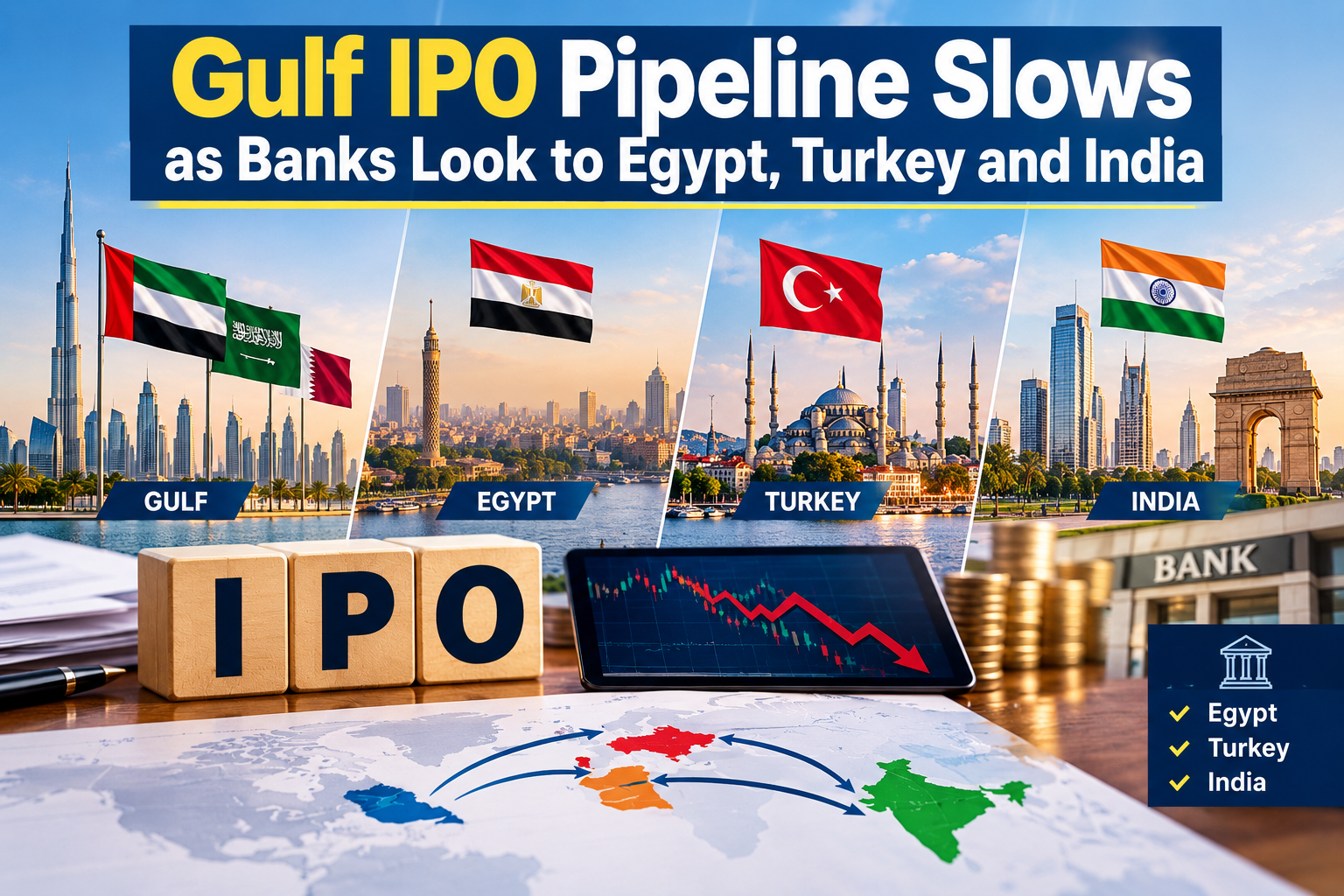
The Gulf’s once-booming initial public offering market is losing momentum in 2026, prompting global investment banks to look beyond the region for new equity-market opportunities. IPO proceeds across the Gulf have fallen below $1.1 billion so far this year, as geopolitical uncertainty and a slowdown in equity issuance weigh on deal activity.
The slowdown marks a shift for a region that had become one of the world’s most attractive destinations for IPOs following the pandemic. Dubai, Abu Dhabi and Riyadh had drawn international banks seeking large mandates as governments and companies increasingly turned to public markets to raise capital.
However, the pace of new listings has weakened, with several potential Gulf deals now appearing more likely to move into 2027.
Gulf IPO Market Faces Slowdown
The Gulf IPO market experienced a strong run in recent years, supported by government-led privatisation programmes, strong investor demand and the growing importance of financial markets in the region.
That momentum has faded in 2026. A prolonged regional conflict has added uncertainty to IPO timelines and made companies more cautious about launching offerings, even though a sizeable pipeline of potential listings remains.
The slowdown has forced investment banks to look for business in other emerging markets where equity issuance remains active.
Banks Turn to Egypt and Turkey
With Gulf IPO volumes declining, major financial institutions are increasingly focusing on Egypt, Turkey and India.
HSBC has expanded its activity in Turkey, particularly in follow-on offerings. Secondary share sales in Turkey have reached around $1.6 billion this year, almost twice last year’s level. HSBC has participated in seven transactions and has led the local rankings, bringing in approximately $552 million compared with $260 million from two deals a year earlier.
EFG Hermes is also increasing its activity outside the Gulf. The investment bank is working on several potential Egyptian IPOs, including a possible Cairo listing of the domestic business of fintech company MNT-Halan alongside Citigroup.
The bank is also advising on planned offerings involving state-affiliated companies such as Banque du Caire and Misr Life Insurance.
India Emerges as Another Key Market
India is also becoming increasingly important for Gulf-based financial institutions looking to expand their investment-banking operations.
Emirates NBD has expanded its investment-banking presence in India and recently acquired a majority stake in RBL Bank. The lender is also seeking to strengthen its equity-market presence in Turkey.
Emirates NBD and First Abu Dhabi Bank are involved in arranging Airtel Money’s London listing, highlighting the growing role of Gulf financial institutions in cross-border capital-market transactions.
The trend reflects a broader shift in the region, with Gulf investors increasingly looking for opportunities outside their domestic markets while international companies seek access to the deep pool of capital available in the Middle East.
Gulf M&A Activity Remains Strong
While IPO activity has weakened, the broader deal-making environment involving Gulf state-backed investors remains active.
Transactions involving Gulf state-backed investors increased by almost 200% in the first half of 2026 to around $300 billion, creating opportunities for banks in mergers and acquisitions even as equity-capital-market activity slows.
This has allowed major banks to maintain their Middle East businesses despite the weaker IPO pipeline.
HSBC, for example, has not completed a Gulf IPO so far in 2026 but continues to work on more than 50 active assignments covering mergers and acquisitions and equity-related transactions across Turkey and the Middle East and North Africa region.
Gulf IPOs Could Return
Despite the current slowdown, bankers remain optimistic about the long-term outlook for Gulf capital markets.
The region continues to have a strong pipeline of potential IPOs, particularly in Saudi Arabia. However, several deals may be delayed until market conditions become more favourable.
The current environment also marks a change in the type of transactions attracting financial institutions. In earlier years, governments frequently sold stakes in major state-owned or state-linked companies to deepen local stock markets. More recently, banks have increasingly turned to M&A and take-private transactions to generate fees.
Africa Also Gains Investor Attention
The slowdown in Gulf IPOs has also highlighted the growing importance of African equity markets.
Sub-Saharan Africa has raised approximately $1.37 billion through IPOs in 2026, already exceeding the Gulf’s tally. The gap could widen significantly if Dangote Petroleum Refinery completes its planned listing, which is expected to raise at least $1.6 billion.
This would make the offering one of the largest IPOs in Africa and further demonstrate how investment-banking activity is shifting across emerging markets.
For investors and financial institutions, the changing IPO landscape means that markets such as Egypt, Turkey, India and parts of Africa could become increasingly important sources of equity-market activity while the Gulf works through its current pipeline.
The Gulf remains a major financial centre, but the 2026 slowdown shows that global banks are no longer relying solely on Dubai, Abu Dhabi and Riyadh for IPO mandates.
Instead, they are following capital and deal activity into markets where new listings and secondary offerings are currently gaining momentum.
For more such information, visit EQMint
Join our WhatsApp channel for timely updates: Whatsapp