

Author: Aadarsh Patel | EQMint
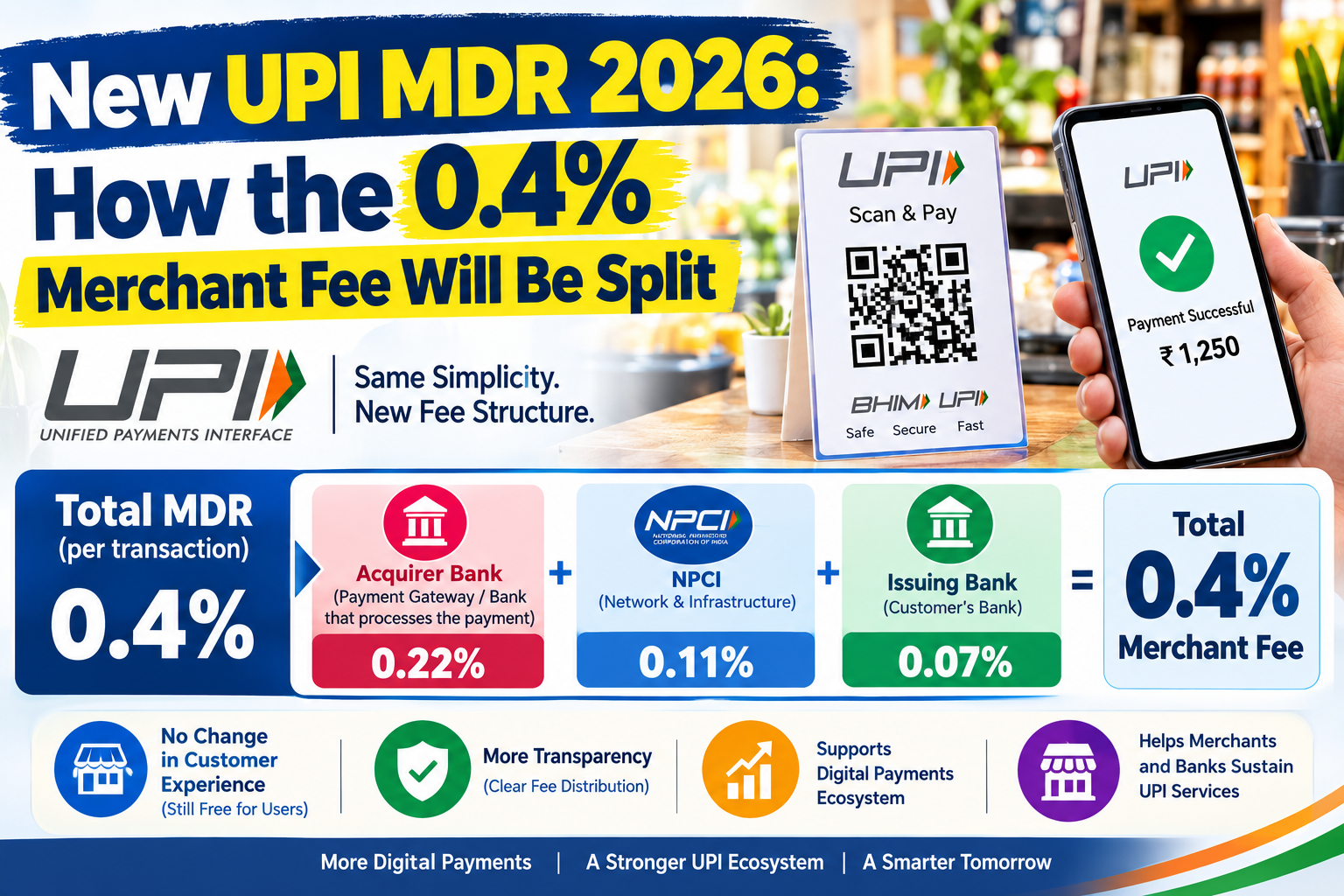
A new Merchant Discount Rate (MDR) framework for certain UPI transactions is set to take effect from October 15, 2026, introducing a 0.4% charge on specified merchant payments above ₹2,000. The fee will be borne by merchants rather than consumers, while several categories of UPI transactions will continue to remain free.
The new framework has raised questions about where the merchant fee will go and how the revenue will be distributed across the UPI ecosystem.
What Changes Under the New UPI MDR Framework?
Under the proposed structure, person-to-person (P2P) UPI transfers will continue to remain free, irrespective of the transaction amount.
Merchant payments of up to ₹2,000 will also remain free. For specified merchant transactions above ₹2,000, however, a 0.4% MDR will apply.
Small merchants will receive additional protection. Street vendors and small businesses receiving up to ₹1 lakh per month under the P2PM category will continue to operate at zero MDR.
Recurring transactions, including UPI Mandates, AutoPay, subscriptions and utility bill payments, will also remain outside the MDR framework.
For example, if a customer makes a ₹10,000 eligible merchant payment through UPI, the MDR would amount to ₹40, excluding GST. The customer would not be charged this amount directly.
How Will the 0.4% UPI MDR Be Distributed?
The MDR collected on an eligible transaction is expected to be distributed among several participants involved in processing the payment.
| UPI Ecosystem Participant | Share | Amount: ₹40 MDR |
|---|---|---|
| Issuing Bank | 40% | ₹16 |
| Acquiring Bank | 30% | ₹12 |
| UPI App | 20% | ₹8 |
| Payer PSP | 10% | ₹4 |
The figures are exclusive of GST.
Issuing Bank: 40%
The issuing bank is the bank holding the customer’s account. It authorises the transaction and processes the debit from the customer’s account. Under the proposed distribution, it receives the largest share of the MDR at 40%.
For a ₹40 MDR, this would translate into ₹16.
Acquiring Bank: 30%
The acquiring bank is the merchant’s bank and is responsible for receiving and settling the payment into the merchant’s account.
It would receive 30% of the MDR, or ₹12 on a ₹40 fee, under the proposed split.
UPI App: 20%
The UPI application used by the customer, such as Google Pay, PhonePe or Paytm, would receive 20% of the MDR.
On a ₹40 fee, the app’s share would be ₹8.
The revenue-sharing component is significant for India’s digital payments ecosystem because UPI apps have historically operated without directly earning MDR from UPI merchant transactions.
Payer PSP: 10%
The remaining 10% would go to the payer’s Payment Service Provider (PSP), the banking layer that connects the UPI application with the UPI network.
Although users generally do not see this layer when making a payment, it plays a role in routing and processing UPI transactions.
Why Is UPI MDR Being Introduced?
UPI has operated with zero MDR on merchant transactions since 2020, following the government’s decision to remove charges to accelerate the adoption of digital payments.
The proposed MDR framework comes as transaction volumes across the UPI ecosystem continue to expand, increasing the infrastructure, technology, cybersecurity and operational requirements involved in processing payments.
The framework is intended to create a revenue mechanism for participants across the UPI ecosystem while retaining zero-cost access for consumers in several major transaction categories.
A portion of the MDR collected is also reportedly expected to support a dedicated fund aimed at expanding UPI adoption among smaller merchants.
What Does the New UPI Charge Mean for Consumers?
For most consumers, the change will not result in a direct additional charge.
P2P transfers will remain free, while merchant payments up to ₹2,000 will continue to carry no MDR. The 0.4% charge applies to specified merchant transactions above the threshold and is deducted on the merchant side.
This means a customer paying ₹10,000 through an eligible UPI merchant transaction would still make a ₹10,000 payment. The merchant, however, would face an MDR of ₹40, before applicable GST.
What Does It Mean for Merchants?
For merchants handling larger-value UPI transactions, the new framework could result in a deduction from their settlement amount.
A merchant receiving an eligible ₹10,000 payment, for instance, would have a 0.4% MDR applied to the transaction, translating to ₹40 before GST.
At the same time, merchants covered under the P2PM category and receiving up to ₹1 lakh a month would continue to be exempt from MDR under the proposed framework.
The impact will therefore differ depending on a merchant’s transaction value, category and monthly UPI receipts.
UPI’s Shift From Zero MDR
The introduction of an MDR marks a significant change for India’s UPI ecosystem after more than six years of zero-MDR merchant payments.
Unlike traditional card transactions, which have historically involved merchant fees, UPI was promoted as a low-cost digital payment system with MDR removed to encourage widespread adoption.
The new framework attempts to introduce a revenue-sharing mechanism while retaining free UPI access for consumers and protecting smaller merchants.
With the October 15 implementation date approaching, merchants, banks and payment applications will be watching how the new structure affects transaction economics and the broader digital payments ecosystem.
For more such information, visit EQMint
Join our WhatsApp channel for timely updates: Whatsapp